
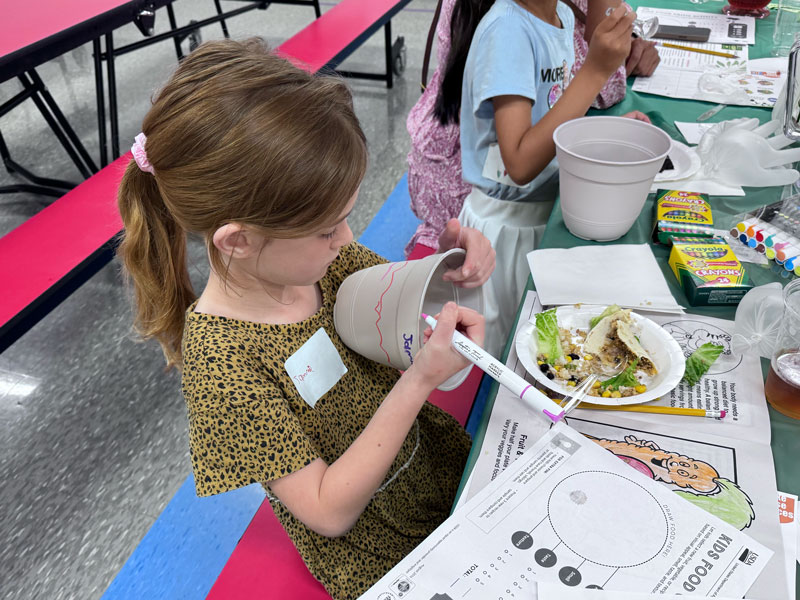
Students are key collaborators in creating more nourishing school meals that align with their needs and preferences. This belief was shared by several Lake Michigan School Food System Innovation Hub grantees, whose projects are underway across the region, at a meeting earlier this year.
This April, school food leaders from Illinois, Indiana, Michigan, and Wisconsin came together at the Innovation Hub—not only to exchange ideas but also to champion a powerful truth: students belong at the center of every school meals decision.
Here are the ways they’re doing it—and how you can, too.
Imagine the Future
The goal of Buy Local, Cook Fresh Illinois – a collaboration with nonprofits, farms, food businesses, and three rural schools in Central Illinois – is to teach school food teams to cook from scratch using local ingredients.
To kick off the project, students and staff came together to discuss what they wanted to eat and cook. “Working hand-in-hand with the students, [learning] what they like, what they don’t like, ensures that when that product comes out, the students enjoy it,” said Greg Christian, founder of Beyond Green Partners and Sustainable Food Institute of America.
Students aren’t typically engaged in this kind of strategic work, Greg said. “We sit with them, [asking] ‘What do you want to do?’, ‘Why do you want to do that?’, ‘What’s going to get [in] your way?’ And then we write the visions.”
Harvest Together
Escuela Verde, a small, public charter high school in Milwaukee, is collaborating with Hundred Acre Farm, a local, urban hydroponic farm, to train students in growing and preparing greens.
First, students visit the farm to get hands-on training on growing greens in a hydroponic environment. Later, when they’re able to bring the greens back to the school, they develop recipes to use them at their student-run New Line Cafe. “We put them in sandwiches, salads, wraps,” said Escuela Verde Advisor Monica Beltran. “We also explore different ways of using each of the greens.”
Allowing the students to lead the recipe development “really open[s] our students to explore how to use what you have,” she continued, “and also explore different careers and ultimately gain life skills.”
The Food Futures Project, a school food system collaboration in Michigan’s Upper Peninsula, is rooted in student voice and choice. First, the students decided to work with potatoes, a popular ingredient in school meals and a crop that grows well in the region. Then, they helped plant and harvest 300 pounds of them. Next, the potatoes were transported to Northwoods Test Kitchen to be sliced and frozen for use in their school meals. Now, school food leaders are finding ways to incorporate smaller-scale processing equipment into their kitchens to make prep more economical and efficient.
“We used student voice through taste tests and school involvement to guide the process of [deciding] what students want to see grown and served in their cafeterias,” said Alison Stawara, farm manager at Partridge Creek Farm.

Try Taste Tests
As they were developing a new black bean and beef burger patty for Proviso Township High School, partners McCann Meat Company and Common Market Great Lakes gathered 55 students to weigh in.
The students took part in taste tests during health class at the school, which is in western Cook County, near Chicago. They sampled the traditional beef patty served across the school system, and then the new product, which has less saturated fat and sodium and more fiber and also supports local food producers.
“The majority of [students] said they liked the flavor; they just said that the texture was a little different for them,” said Assistant Manager of Nutrition Services Roberto Gonzales. “So, we spoke with the producer [and] let them know that the kids said it was a little bit too tight—more like a sausage rather than a burger. We’re working with them to see how we could potentially get a better product [for] students.”
Take a Poll
Rooted School Indianapolis’s Cooking Club is a celebration of healthy living through hands-on-cooking. The biweekly class of 20 students, which launched in February 2025 and continued through the end of the school year, has become so popular that they’re now rotating students in and out of the program.
The Cooking Club began their work by surveying the students about their preferences. “Students voted on recipes … we incorporated their voices, and it brought more excitement,” said Ma’at Lands, the executive director of the free public charter school on Indianapolis’s Eastside. “We’re finding different ways to incorporate students, so that they can also see that they can do it at home.”
The project partners’ monthly meetings include a student representative. Based on the survey and his feedback, the school created a salad bar — a feature that students love.
Create Take-Home Tools
A recent series of student taste tests in LaCrosse, Wisconsin, facilitated by the Division of Extension at University of Wisconsin, Madison, featured produce grown by local Hmong farmers.
“The students were very explorative, and they looked forward to every taste test,” said Hmong Nutrition Educator Emily Yang. “They applied the knowledge that they learned in creative ways, [such as] trying plain popcorn with cilantro.”
Each student received cards with information about the vegetables they ate, including the different varieties, the Wisconsin growing season, where to purchase it, how to store it, how to eat it, and how it’s traditionally prepared.
The cards featured images of the vegetable as a whole, said Emily. “For students, it just made a lot more sense to them where that vegetable came from and how to eat it.”
Get Support for Your Project
When students have a role to play in school meal decision-making, planning, and prep, they are more likely to enjoy their meals—and to think more expansively and creatively about their connection to the local food system.
Do you know a way to make school meals more local, more nourishing, and more loved? Learn more about Lake Michigan School Food System Innovation Hub grant opportunities.