
For local farmers and food businesses, schools are important and often untapped markets. However, finding a way in can be a challenge.
“There are so many barriers to getting food into K–12 schools,” said Gary Cuneen of Seven Generations Ahead, the Illinois State Lead for the Lake Michigan School Food System Innovation Hub. “Schools aren’t going to buy local fresh food if they don’t know what to do with it or have the equipment.”
In Illinois and beyond, USDA-funded Lake Michigan School Food System Innovation Hub grantees are strengthening the connection between demand and supply.
Professional Development for School Food Professionals
“Buy Local, Cook Fresh Illinois” is a 2024 Innovation Collaborative-funded project led by Chicago-based preschool catering company Beyond Green Partners. In partnership with the Illinois State Board of Education and Sangamon County, they have helped three rural Central Illinois schools transition their food service programs to scratch-cooking operations that use locally sourced ingredients.
At each school, Beyond Green has led four on-site training sessions, designed for school food professionals to learn and practice skills such as recipe development, preparation techniques, equipment use, and more. They also offer a four-day intensive program in the summer and ongoing support through virtual meetings and two online platforms—Basecamp and Teachable.
“We built roadmaps for these schools,” said Greg Christian, founder of Beyond Green Partners.” Then we give them homework as they go on the roadmap.”
“Buy Local, Cook Fresh Illinois” sources ingredients from local producers that include Janie’s Mill, an artisanal local grain mill and women-owned business based in Ashkum, Illinois, as well as 4 Lees Farm, Moon Girl Farm, and FarmFED, a Central Illinois farmer co-op.
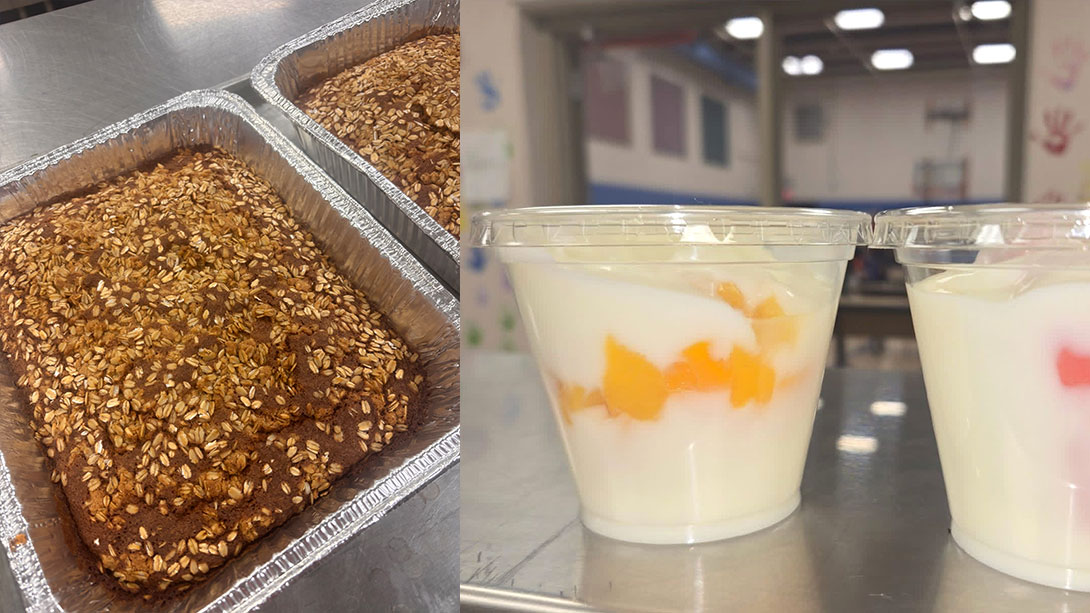
Creating and nurturing these partnerships expand opportunities for farmers and food producers and for the students whose meals are more local, more nourishing, and more loved. For example, thanks to this project, New Berlin Community Unit School District 16 is now serving Homemade Pancakes (made with local Janie’s Mill Flour), Cinnamon Oat Bread (made with local Janie’s Mill Oats), and a yogurt parfait with Homemade Granola (made with local Janie’s Mill Oats).
Farmer-Led, Cross-State Cooperation
As impactful as projects like “Buy Local, Cook Fresh, Illinois” are for students and school food systems, they are equally valuable for farmers and food producers. FarmFED, for example, now receives more consistent demand for their products.
This also has been the experience of the farmer-led co-op Wisconsin Food Hub Cooperative (WFHC), which leads the Lake Michigan School Food System Innovation Hub-funded project “Building a Farm to School Logistics and Pricing Model for the Great Lakes Region.”
WFHC’s new Super Transport Cooperative (STC) is creating more sustainable ways for its members to reach markets across Wisconsin—and even to offer the same products at the same price as traditional distributors.
The group began in a casual way, said Tara Roberts-Turner, WFHC general manager. “We had deep relationships, and we called together partners—some [who] had vehicles—to find new ways to work together.”
Now, the group has streamlined their processes. “We’re filling the whole truck, which makes a run more beneficial and most price efficient,” said Roberts-Turner. They’ve established themselves as an LLC and meet a couple of times a month.
“I believe the long-term investments we are making now will lead us to a more sustainable project by reducing transportation costs and providing us with stronger relationships with suppliers and customers,” said Roberts-Turner.
With the support of Wisconsin’s Department of Public Instruction, Department of Agriculture, Trade and Consumer Protection, and other state systems, the STC will continue to provide small farmers and food producers opportunities to contribute to a more robust supply chain.
Learn how the Wisconsin Food Hub Cooperative’s Tend & Table Boxes are bringing fresh, local ingredients directly to schools.
That’s Not All!
Connecting local food to schools requires more than interest. It requires infrastructure, coordination, and partners willing to solve problems together. Across the region, Innovation Hub projects are helping schools and suppliers navigate the real-world logistics of scale, volume, and preparation, so local food can move reliably from farms to cafeterias.
“A lot of suppliers don’t have any idea [of] the volume of food that’s needed. We started out dreaming big and thinking we’re going to make our project districtwide. And the reality is that [for] local suppliers, when you go in and you say, ‘Well, I need 6,000 pounds of carrots cut and ready to eat,’ they say, ‘Oh my gosh, how do I even do that?’ Part of our journey has been to find an entity that would aggregate for us and then cut and prepare.”
–Kymm Mutch, Founder of Mutch Better Food LLC
Partner, Good School Food: A Community-Driven, Food System Approach to Expand Healthy School Meal Options in Milwaukee, a 2024 Innovation Collaborative Grantee
This behind-the-scenes coordination—between schools, farmers, food hubs, and processors—is what makes local sourcing possible at scale. By investing in training, aggregation, and shared logistics, Innovation Hub partners are building systems that work not just for individual schools, but for entire regions.