
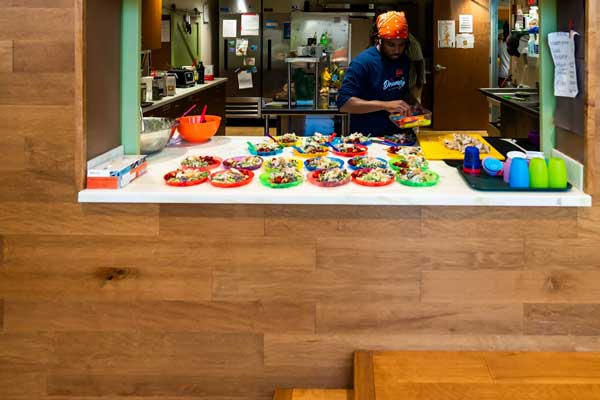
The idea for School Meal Sparks struck Kirsten Strong, the resident dietitian of Kalamazoo Public Schools, as she sampled school meal-appropriate dishes prepared by culinary arts students at Kalamazoo Valley Community College (KVCC). Invited as a guest to try their culinary creations at the close of their semester, Strong wanted to find a way to provide more educational support to her food service staff. She recalled from her own experience the steep learning curve around the logistics of creating school menus, which includes following federal guidelines on what is served, as well as maintaining records. From here, work on a six-part workshop series began.
Now, School Meal Sparks’ free classes provide resources and strategies needed to expand purchasing and integration of local food in school settings.
The project is made possible by a grant from the Lake Michigan School Food Innovation Hub, which is supported by the United States Department of Agriculture’s Food and Nutrition Service, and convened by the Illinois Public Health Institute. The Innovation Hub funding supports one-year projects focused on the school food system and school meal product improvements, such as planning, product testing, research sharing, and enhancing skills and knowledge.
ValleyHUB, a social enterprise food hub that is a program of KVCC, was able to support the research, development, implementation, and evaluation of the in-person workshop series focused on supporting food service staff across Southwest Michigan.
School Meal Sparks participants came motivated to learn how to incorporate more local ingredients into their menus in a sustainable way. They were served innovative local dishes, from roasted asparagus to kale and apple salad, which modeled what could be provided in cafeterias. Farmers, chefs, dietitians and local food service directors acted as presenters for these events, which ranged from two hours to full-day classes. These workshops were designed to build connections, skills, and self-efficacy in utilizing Michigan produce in the cafeteria.
Lack of capacity, budget, and recipes to incorporate local foods into school menus are frequent barriers to utilizing local produce. District food service staff described challenges related to staff buy-in and the time needed to establish new recipes in their records. Over the course of the workshops, the importance of soliciting food service staff input and engagement emerged as crucial for maintaining local food on menus. Presenters found that engaging attendees through tasting culinary trends and seasonal foods led to excitement.
Throughout this series, relationships formed among the workshop participants. In particular, the leaders of the smaller districts expressed enthusiasm for meeting colleagues from other communities. However, as the series progressed, ValleyHUB found that representatives from larger school districts, with more buildings and staff, could attend more consistently. Staff members from the smaller, outlying districts had more difficulty finding capacity to attend the Kalamazoo-based workshops.
To address this barrier and increase access to the information provided through the workshops, ValleyHUB trainers traveled to offer onsite workshops for front-line staff in four different districts. Recordings and materials from these workshops are available through ValleyHUB’s online resource library for other districts interested in local food purchasing and count toward food service staff’s professional development credits.
Over the course of the series, attendees continued to request more support for recipe development and share the benefits of connecting with professional development opportunities in their districts whenever possible. “The School Meal Sparks workshop series underscored that food service directors are hungry for support with the nuts and bolts of their jobs,” said Rachel Bair, Director for Sustainable Food Systems at KVCC.
With the Lake Michigan School Food System Innovation Hub, food service staff across Southwest Michigan were provided with resources and connections to build local communities of practice going forward. Building on the lessons learned, Southwest Michigan schools are deepening their capacity, all in the name of feeding kids more healthy, local foods.